Aetiology

1. Genetic transmission

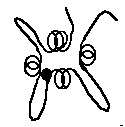
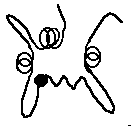
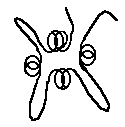
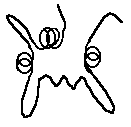
A number of the human prion diseases are usually or always inherited in a Mendelian dominant fashion. They are due to mutations in the gene for PrP, which presumably make the protein less stable and more likely to undergo the conformational change into the pathogenic form. A number of such mutations have been characterised in different families.

In some cases of GSS, a mutation at codon 102 results in the substitution of a leucine for a proline residue.

Common genetic variants of the prion protein gene modify susceptibility to iatrogenic and sporadic forms of CJD, and also modify the clinical features in familial cases due to major mutations.

2. "Sporadic" cases

A number of cases of CJD appear to be sporadic. It may be that chance events occasionally lead normal PrPc to take up an abnormal conformation.

3. Iatrogenic transmission

Transmission from one CJD patient to others has occurred through the use of cerebral electrodes, corneal transplant, dura mater graft, growth hormone injection.

There is now good evidence from in vitro and in vivo studies that abnormal prion protein can trigger a conformational change in normal host protein, leading to disease.
PrPsc can induce conformational change in PrPc, although the mechanism whereby this is achieved is unknown

4. Ingestion

The example of kuru demonstrates that human prion diseases can be transmitted by the oral route. Since the practice of cannibalism among New Guinea tribesmen was discontinued in the 1950's the disease has died out.

5. Other forms of transmission

The bulk of evidence suggests that vertical transmission of prion diseases does not occur.

Horizontal transmission (apart from through mechanisms involving inoculation) also probably does not usually occur. Transmissible mink encephalopathy tends to affect most animals on a ranch, but this may be because of fighting and cannibalism.

Transmission via blood transfusion has not been demonstrated, although some centres now seek to exclude CJD donors.

6. Transmission between species

There are some genetic differences between prion proteins from different species, and these act as a barrier to transmission. Nevertheless, infection between species has been repeatedly demonstrated in experimental situations. It is more difficult to produce infection via the oral route than through direct cerebral inoculation.

GSS has been transmitted to monkeys and rodents by intracerebral inoculation. Genetic forms of CJD can be transmitted to primates and capuchin monkeys by inoculation. FFI can be transmitted to mice by inoculation.

BSE is commonly thought to have been acquired by cattle exposed to scrapie in feed.

BSE has been transmitted to cattle, mice, sheep, and goats orally and to pigs and marmoset monkeys by inoculation. Feline spongiform encephalopathy first appeared in 1990, and so may result from oral transmission of BSE to cats.