Causes of association - 3: Population stratifications
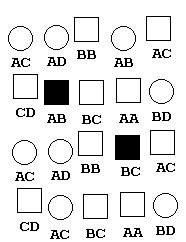
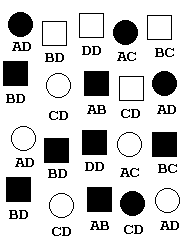
If there are subgroups within the population who do not tend to mate with each other, then it may be that certain marker alleles are commoner within a subgroup, and also that the disease is commoner with the same subgroup. If this happens a "spurious" association will be observed.
The disease and marker allele D are both rare in the first group but common in the second. When cases and controls are sampled from the whole population the disease appears to be associated with the D allele,
even though they are not associated in either subgroup.